
There are invitations that signal something beyond logistics. When Redbox Media extended an invitation to experience Résidences Boutique at Mont-Tremblant, it was less a property tour than a deliberate orchestration—a curator's gesture introducing a client to a body of work. The reception itself became part of the design argument.
Arrival and Architecture
The gated community announces itself with restraint. Security and exclusivity are handled as infrastructure rather than theater. You pass through nothing that performs; everything that functions. By the time the chalet emerges from the forest density, you're already inside the design logic.
The scale registers first. High ceilings—not maximalist gesture, but genuine spatial volume—create the foundation for everything that follows. This is a multi-room cottage that refuses miniaturization. Each room breathes. Each volume speaks to the others without competition or hierarchy.
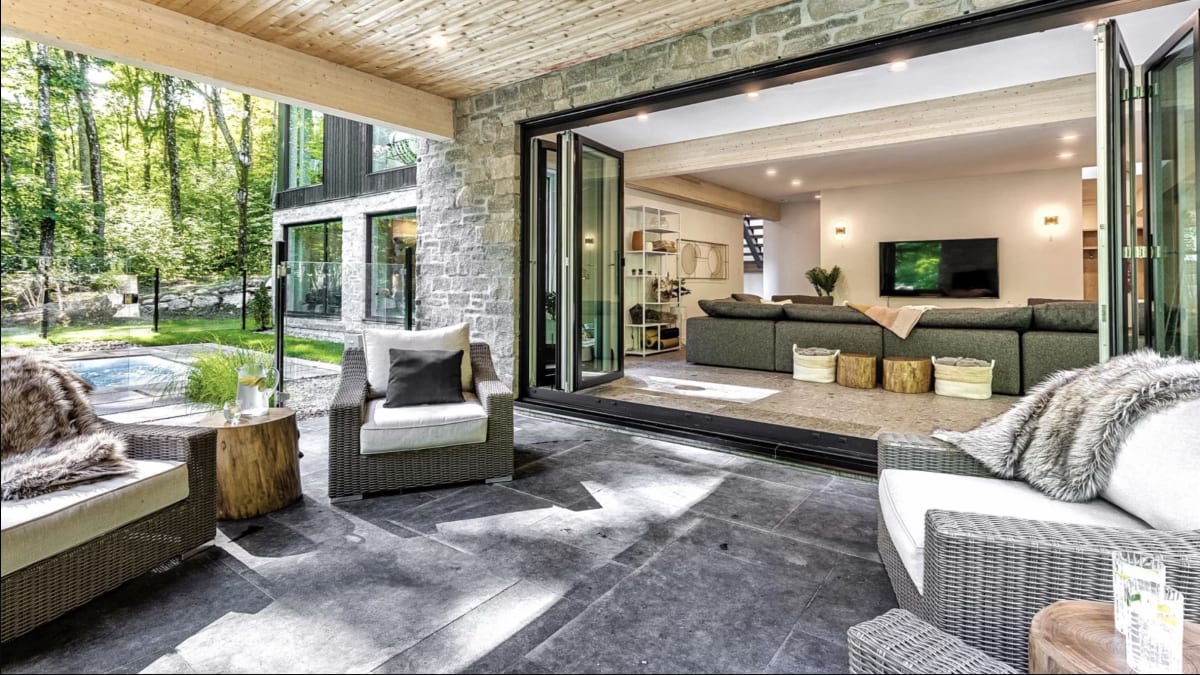
What strikes immediately is the coherence. Modern touches—clean lines, material simplicity, refined fixtures—rest entirely naturally within a structure that remains fundamentally connected to its forest context. This is not nature dressed up in contemporary clothing. It's contemporary design that understands it's in conversation with landscape. The distinction is everything.
The furniture pieces deserve specific attention. These are not decorator selections culled from catalogs. Each piece appears to have been considered against the specific volume it occupies, the light it receives, the function it serves. Scale is impeccable. Material choices—timber, leather, stone—extend the architectural logic rather than interrupt it. You feel the difference immediately: luxury as clarity, not accumulation.
The Hospitality of Generous Space
There is no luxury without respite. And respite demands space—particularly in bathrooms, the rooms where comfort becomes non-negotiable.
The main floor bathroom announces this principle immediately. Upon entry, the volume is so generous, so well-proportioned, that your first instinct is to question whether a toilet exists at all. It does—elegantly concealed behind a privacy wall, positioned beyond the primary bath area. This is not minimalism performing as luxury. This is genuine spatial abundance, where the bath itself becomes an architectural statement: a substantial basin set within a volume that gives it proper dignity.
Each bedroom maintains this standard with its own ensuite. The lower level repeats the commitment: an equally generous washroom that signals to visiting guests that no one will compromise on comfort in this property.
"The bathroom reveals everything. When bathrooms are spacious, when they're finished with the same architectural consideration as living areas—that's when you know someone actually understands hospitality." Daniel A. Stanford · MODUS Editor in Chief
The Catering Argument: Architecture as Theater
The reception meal was not performance hospitality. It was evidence of discipline.
A familiar face, Chef Hamza Bousaidan, was present—positioned not in back-kitchen obscurity, but in a spacious, open kitchen concept that made food preparation itself part of the experience. Surf and turf became the proposition: premium lobster and beef, with Chef Bousaidan executing cuts and sears with visible precision.
Tony Constantineau, founder and engineer by trade, orchestrated this property as an expression of his vision. Working alongside architect Marie-Hélène Day—whose approach to La Villa du Chasseur revisited raw, generous volumes with precision while honoring their essential character—and interior designer Mélanie Kusik of LUSINE mobilier design, Constantineau designed a kitchen that could withstand transparency, that could actually perform as a gathering space.
As Constantineau himself articulates the philosophy: "Designed with exceptional architects, craftspeople, and designers, each detail reflects a demand for beauty and craftsmanship." This isn't rhetoric. It's operational principle.

The large dining table completes the narrative: a substantial surface capable of hosting a troupe of influencers, guests, and collaborators. This is architecture for collective experience, not isolated luxury. The table's scale and positioning within the open kitchen and dining volume creates the psychological space for genuine gathering—where conversation flows, where the meal becomes the event, where hospitality operates at the level of community.
Exceptional catering operates on a principle: nourishment should never announce itself as service. The food was simply excellent—thoughtfully sourced, properly prepared, presented with clarity. No fussiness. No attempt to signal luxury through complexity. Just the quiet confidence of people who know how to cook well.
The Design Conversation
Moving through the spaces, the design conversation becomes apparent. Here is a chalet that has refused several obvious traps:
- It does not apologize for being modern. The materials, the lines, the material palette are contemporary. There is no false rusticity, no timber-and-stone performance designed to announce "we're in the country now."
- It does not forget that it sits in a forest. Windows are positioned to activate landscape views. The material palette speaks to the surrounding environment without mimicking it.
- It understands scale. Every volume is appropriately proportioned. The high ceilings don't overwhelm; they frame. The rooms don't compete; they flow.
- It prioritizes experience over amenity. Luxury touches are secondary to the primary offer: an environment that works. Where light moves correctly. Where you can think, gather, or be alone without friction.

Photography: Daniel Armon Stanford · Featuring: Cuisine Artiste My
Meeting the Architects of Experience
Redbox Media's creative leadership—Nader Bou Matar and Alex Barr—were present and engaged as genuine hosts, not as salespeople. These are epicureans who have made it their mission to redefine what hospitality actually means.
Most luxury property teams approach their work as operators solving logistical problems. Bou Matar and Barr approach it as curators solving aesthetic and experiential ones. They weren't presenting a product; they were demonstrating a philosophy. The reception—the calibration of the chef's presence, the selection of menu elements, the pacing of the evening—was orchestrated by people who understand that hospitality is an art form, not a service category.
The exclusive launch event features a curated roster of world-class collaborators: Chef Hamza Bousaidan overseeing culinary experience, Richard Aubé as guest speaker, and Nicolas Pomerleau, local winemaker, curating the beverage program.

Photography: Daniel Armon Stanford · Featuring: Cuisine Artiste My
The Unspoken Argument: Talent, Culture, and the Future of Work
Beneath the surface of this reception lies a more strategic proposition—one that speaks directly to a contemporary crisis in corporate culture.
In the extremely competitive market for top talent, the battle for retaining excellence has become fiercer than ever. Since the end of Covid, companies have attempted everything imaginable to force staff back to traditional office routines. Yet the majority of top talent has refused.
Bou Matar and Barr have inverted the problem. Instead of bringing people back to the office, they've reimagined the office experience entirely—creating an environment where team building becomes an experience worth competing for.
"Create an experience so exceptional, so architecturally sophisticated, that your top talent doesn't just accept the invitation—they compete to be included." On the Résidences Boutique proposition
The Lasting Argument
What lingers after a reception like this is not the catering or the photographs, though those were excellent. It's the conviction that you've witnessed people who understand what they're doing.
A luxury property that achieves coherence across this many dimensions—architectural clarity, material integrity, hospitality discipline, territorial positioning, team alignment—is rare. Most luxury properties solve one or two problems excellently and accept compromise on the others. Résidences Boutique refuses that compromise.
- The design language is contemporary without apology and natural without nostalgia
- The hospitality is generous without performance
- The team's commitment to individual property positioning rather than scaled redundancy
- The operational infrastructure that protects what's been built rather than exploiting it
We left the reception with confirmation that certain people, certain teams, certain design practices still prioritize the difference between good and excellent. That commitment is precisely what separates these properties from the countless luxury chalets that perform the aesthetic of mountain living without understanding its discipline.
Mont-Tremblant: La Villa du Chasseur · La Forêt Boréale · Le Mont-Tremblant
Charlevoix (Le Massif): Le Saint-Laurent · Le Charlevoix
Certaines invitations signalent quelque chose qui dépasse la logistique. Quand Redbox Media a étendu une invitation à découvrir les Résidences Boutique à Mont-Tremblant, il s'agissait moins d'une visite de propriété que d'une orchestration délibérée — le geste d'un curateur présentant à un client un corpus d'œuvres. La réception elle-même est devenue partie intégrante de l'argument de design.
Arrivée et Architecture
La communauté fermée s'annonce avec retenue. La sécurité et l'exclusivité sont traitées comme une infrastructure plutôt que comme un théâtre. On ne franchit rien qui ne soit utile ; tout fonctionne. Au moment où le chalet émerge de la densité forestière, on est déjà à l'intérieur de la logique de design.
L'échelle s'impose d'abord. De hauts plafonds — non pas un geste maximaliste, mais un véritable volume spatial — posent les fondations de tout ce qui suit. Chaque pièce respire. Chaque volume dialogue avec les autres sans compétition ni hiérarchie.
Ce qui frappe immédiatement, c'est la cohérence. Les touches modernes — lignes épurées, simplicité matérielle, luminaires raffinés — reposent de façon tout à fait naturelle au sein d'une structure qui demeure fondamentalement connectée à son contexte forestier. Ce n'est pas la nature habillée de vêtements contemporains. C'est un design contemporain qui comprend qu'il est en conversation avec le paysage.
Les pièces de mobilier méritent une attention particulière. Chaque pièce semble avoir été considérée en fonction du volume spécifique qu'elle occupe, de la lumière qu'elle reçoit, de la fonction qu'elle remplit. Les choix de matériaux — bois, cuir, pierre — prolongent la logique architecturale. On perçoit immédiatement la différence : le luxe comme clarté, non comme accumulation.
L'hospitalité de l'espace généreux
Il n'est pas de luxe sans respiration. Et la respiration exige l'espace — particulièrement dans les salles de bain, ces pièces où le confort devient impératif.
La salle de bain du rez-de-chaussée annonce ce principe immédiatement. En entrant, le volume est si généreux, si bien proportionné, que le premier réflexe est de se demander s'il y a même des toilettes. Il y en a — élégamment dissimulées derrière une cloison de confidentialité. Ce n'est pas le minimalisme qui se performe en luxe. C'est une véritable abondance spatiale.
Chaque chambre maintient cette norme avec sa propre salle de bain attenante. Le niveau inférieur répète l'engagement : une salle de bain tout aussi généreuse qui signale aux visiteurs que personne ne compromettra le confort dans cette propriété.
« La salle de bain révèle tout. Quand les salles de bain sont spacieuses, finies avec la même considération architecturale que les espaces de vie — c'est là qu'on sait que quelqu'un comprend vraiment l'hospitalité. » Daniel A. Stanford · Rédacteur en chef, MODUS
L'argument gastronomique : l'architecture comme théâtre
Le repas de réception n'était pas une hospitalité de performance. C'était la démonstration d'une discipline.
Le Chef Hamza Bousaidan était présent — non pas dans l'obscurité d'une arrière-cuisine, mais dans un vaste concept de cuisine ouverte qui faisait de la préparation des plats une partie de l'expérience. La proposition : surf and turf — homard et bœuf de première qualité, exécutés avec une précision visible.
Tony Constantineau, fondateur et ingénieur de formation, a orchestré cette propriété comme l'expression de sa vision. Travaillant aux côtés de l'architecte Marie-Hélène Day et de la designer d'intérieur Mélanie Kusik de LUSINE mobilier design, Constantineau a conçu une cuisine qui pouvait résister à la transparence — qui pouvait réellement fonctionner comme espace de rassemblement.
Comme Constantineau lui-même articule la philosophie : « Conçu avec des architectes, des artisans et des designers exceptionnels, chaque détail reflète une exigence de beauté et d'artisanat. »
La grande table de salle à manger complète le récit : une surface substantielle capable d'accueillir une troupe d'invités et de collaborateurs. C'est une architecture pour l'expérience collective, non le luxe isolé. La nourriture était simplement excellente — approvisionnée avec soin, bien préparée, présentée avec clarté.
La conversation du design
En parcourant les espaces, la conversation de design devient apparente. Voici un chalet qui a refusé plusieurs pièges évidents :
- Il ne s'excuse pas d'être moderne. Il n'y a pas de fausse rusticité, pas de performance bois-et-pierre conçue pour annoncer « nous sommes à la campagne. »
- Il n'oublie pas qu'il se trouve dans une forêt. Les fenêtres sont positionnées pour activer les vues sur le paysage. La palette matérielle parle à l'environnement sans le mimer.
- Il comprend l'échelle. Chaque volume est proportionné de façon appropriée. Les hauts plafonds n'écrasent pas ; ils encadrent.
- Il privilégie l'expérience sur les équipements. Les touches de luxe sont secondaires à l'offre principale : un environnement qui fonctionne.
Photographie : Daniel Armon Stanford · En vedette : Cuisine Artiste My
Rencontrer les architectes de l'expérience
La direction créative de Redbox Media — Nader Bou Matar et Alex Barr — était présente et engagée en tant qu'hôtes authentiques, non comme vendeurs. Ce sont des épicuriens qui ont fait de leur mission de redéfinir ce que l'hospitalité signifie réellement.
L'événement de lancement exclusif met en vedette une liste de collaborateurs de classe mondiale : le Chef Hamza Bousaidan supervisant l'expérience culinaire, Richard Aubé comme conférencier invité, et Nicolas Pomerleau, vigneron local, orchestrant le programme de boissons.
Photographie : Daniel Armon Stanford · En vedette : Cuisine Artiste My
L'argument implicite : talent, culture et l'avenir du travail
Sous la surface de cette réception se trouve une proposition plus stratégique — qui parle directement à une crise contemporaine dans la culture d'entreprise. Bou Matar et Barr ont inversé le problème. Au lieu de ramener les gens au bureau, ils ont entièrement réimaginé l'expérience de bureau.
« Créez une expérience si exceptionnelle, si architecturalement sophistiquée, que vos meilleurs talents ne se contentent pas d'accepter l'invitation — ils se battent pour y être inclus. » Sur la proposition des Résidences Boutique
L'argument durable
Ce qui reste après une réception comme celle-ci, c'est la conviction d'avoir été témoin de personnes qui comprennent ce qu'elles font. Une propriété de luxe qui atteint une cohérence à travers autant de dimensions est rare. Les Résidences Boutique refusent le compromis.
- Le langage de design est contemporain sans excuses et naturel sans nostalgie
- L'hospitalité est généreuse sans performance
- L'engagement de l'équipe envers le positionnement individuel de chaque propriété
- L'infrastructure opérationnelle qui protège ce qui a été construit plutôt que de l'exploiter
Mont-Tremblant : La Villa du Chasseur · La Forêt Boréale · Le Mont-Tremblant
Charlevoix (Le Massif) : Le Saint-Laurent · Le Charlevoix