144 years.
One argument.
The Sagrada Família is not a cathedral. It is technically a basilica — a minor basilica, consecrated by Pope Benedict XVI in 2010, meaning that for sixteen years it has been an active church operating inside a construction site. Mass has been said beneath scaffolding. Tourists have circled the nave while workers poured concrete overhead. The building has been simultaneously the most visited monument in Spain and the longest active construction project in the Western world. Both things are true. Neither diminishes the other.
Gaudí took over the project in 1883, a year after it broke ground under architect Francesc de Paula del Villar. He was thirty-one years old. He would spend the next forty-three years of his life on it, eventually refusing other commissions entirely, living on-site in the workshop beneath the building, surviving on almost nothing, until a tram struck him on the Carrer de Casp on June 7, 1926. He was not recognised immediately — he was dressed so plainly that bystanders assumed he was a beggar. He died three days later. He was buried in the crypt of the building he had spent his life constructing and would never see finished.
"Gaudí designed the Tower of Jesus Christ to stand 172.5 metres — deliberately shorter than Montjuïc, which rises to 177.7 metres. His reasoning: a human creation should never surpass the work of God. That single decision, made by a man who died 100 years before the tower was completed, is still visible in the Barcelona skyline today."
— MODUS Editorial · On Gaudí's restraint
What survived the
Civil War and what didn't.
In July 1936, anarchist militias raided the Sagrada Família workshop and set fire to it. Gaudí's studio, his notebooks, his plaster models — the primary record of his intentions for the unbuilt portions of the building — were largely destroyed. What survived was fragmentary: partial drawings, photographs, a handful of reconstructed models. The architects who would complete the building were working from remnants. This is the context in which the modern construction must be understood. Every decision made after 1936 was an act of interpretation as much as execution — an attempt to reconstruct, from partial evidence, what Gaudí would have done.
Head architect Jordi Faulí and the current team have spent decades doing this work. The completion of the Tower of Jesus Christ — the element for which Gaudí left the least documentation — is their most ambitious act of fidelity. The result is a tower that feels both contemporary in its engineering and ancient in its logic. It does not look like a building designed by a committee working from partial plans. It looks like the building Gaudí drew — which is exactly why standing beneath it is worth the journey.
172.5 metres.
The philosophy of height.
The Tower of Jesus Christ stands 172.5 metres tall and is crowned by a 17-metre cross — equivalent in height to a five-storey building — whose four arms are each oriented toward a cardinal point. Inside the upper arm of the cross, at its highest point, Italian artist Andrea Mastrovito has installed a sculpture of the Agnus Dei — the Lamb of God — exactly as Gaudí envisioned. The lamb is visible from within the cross itself, seen by virtually no one, placed there for the logic of the building and not for the audience.
This is the detail to carry with you when you go: the lamb inside the cross at 172 metres that almost nobody will ever see. It is the purest expression of what the Sagrada Família actually is — a building constructed not for spectators but for a logic that operates whether or not anyone is watching. That is the rarest quality in architecture, and you feel it the moment you step inside.
"A spiral staircase and a panoramic glass lift carry visitors to a viewpoint 164 metres above the city. The view from there — over Barcelona, out to the Mediterranean — is the payoff for 144 years. Go up. It is the single best vantage point in the city."
— MODUS Terrain · The view from the top
Why it belongs
on every bucket list.
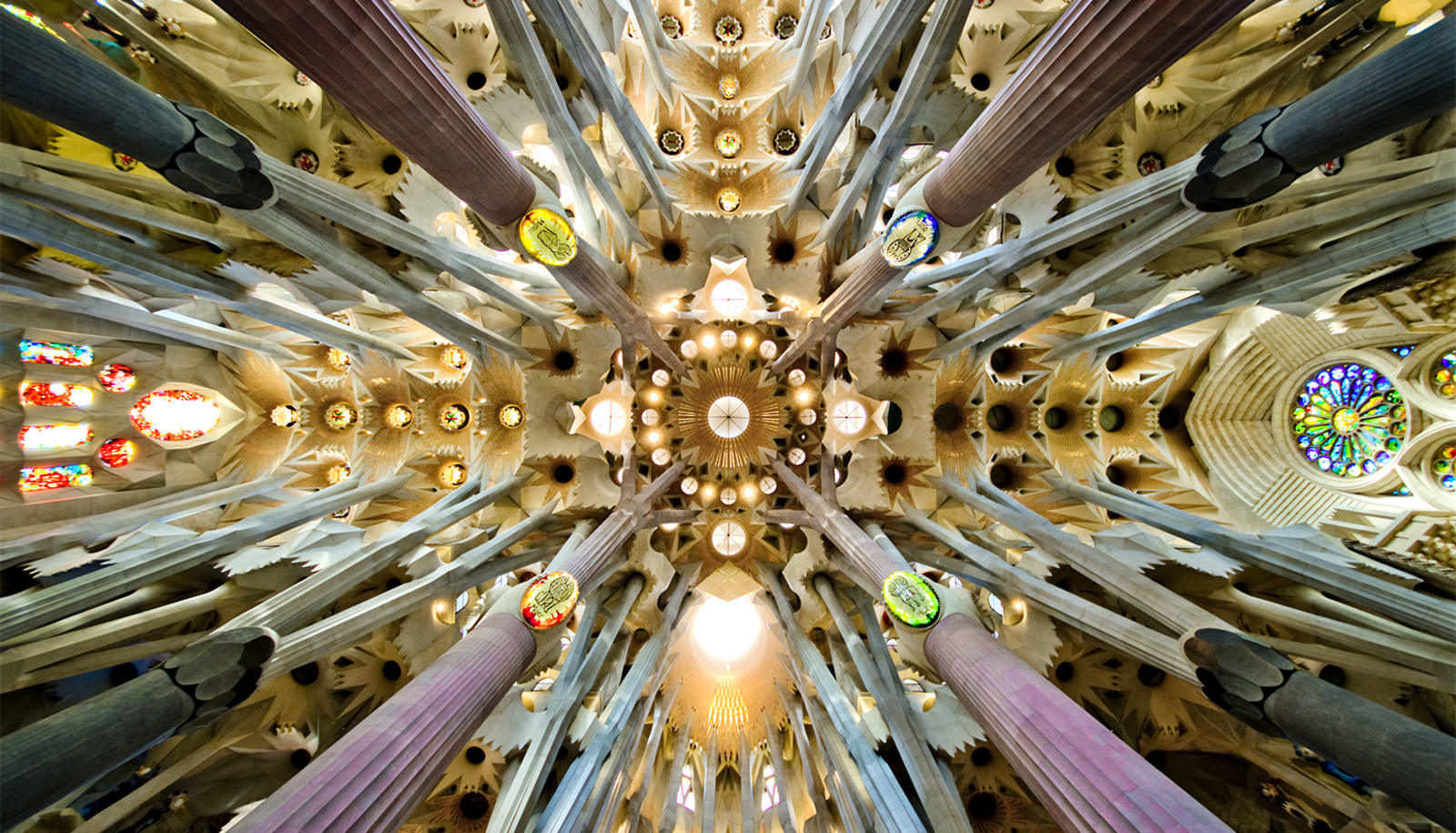
There are beautiful churches, and there are great buildings, and there are famous monuments. The Sagrada Família is the rare place that is all three at once and unlike anything else on earth — a forest of stone columns that bloom into the ceiling, light filtered through glass tuned to sunrise on one side and sunset on the other, and a structure whose logic was set by one mind and carried out across a century. No photograph prepares you for the scale, or the colour, or the silence inside.
It is also, simply, easy to make the centrepiece of a trip. The basilica sits on the Metro, in the heart of a walkable city of beaches, markets, and more Gaudí than any other place on earth. You can build a perfect three- or four-day visit around it without ever needing a car. Few bucket-list destinations are this profound and this effortless to reach at the same time.
See it once. You will understand why a man gave his life to it — and why a city spent 144 years finishing what he started.